
Take the 2-minute Reliability Maturity Assessment and get the Uptime Preservation Playbook — the continuous condition monitoring framework reliability leaders use to close detection gaps in high-throughput operations.
Built for reliability, engineering, and operations leaders in distribution, parcel, cold storage, and airport operations.
Delivered to your inbox. No commitment.
Used by reliability teams at leading distribution and logistics operators

Modern automation in high-throughput facilities — distribution centers, parcel hubs, baggage operations — increases uptime risk because it increases asset interdependence. When a critical conveyor, sorter, or control cabinet goes down, upstream lines block, downstream teams run out of work, and service commitments are immediately at risk.
Inside a tightly-timed or 24/7 operation, lost uptime usually means lost output, not delayed output. The question is no longer whether you can fix it. It's whether you saw it coming.
Product keeps feeding into the failure point, but can't move down the line.
Sortation, loading, and handling teams run out of work the moment the line stops.
In 24/7 environments, lost uptime is lost output — not delayed output. Throughput doesn't come back.
Three questions. Two minutes. Find out whether your current monitoring approach gives you enough time to plan an intervention — or only tells you operations are already grinding to a halt.
Get the Uptime Preservation Playbook for the complete P-F curve framework, the Detection-Impact Matrix, and the 6-stage rollout roadmap.
The goal of continuous condition monitoring is not to detect degradation as early as possible. It's to reduce detection latency — the gap between the first detectable sign of degradation and the moment your team becomes aware of it — so the operation has time to plan ahead.
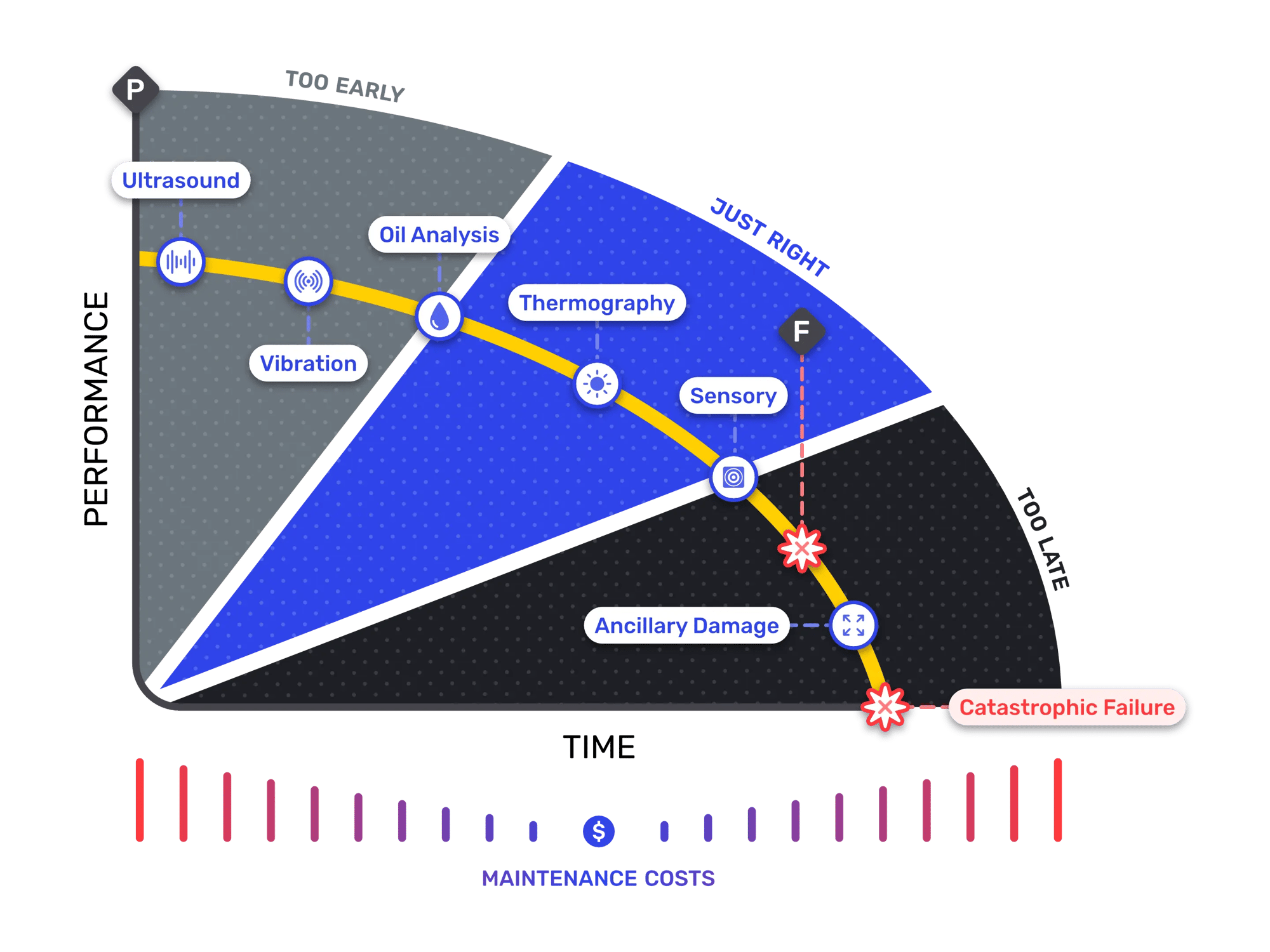
The P-F curve is a practical way to judge whether your current maintenance approach gives you enough time to act before failure affects operations:
P — Potential Failure: the point at which a degradation signal first becomes detectable.
F — Functional Failure: the point at which the asset can no longer perform its intended function.
P-F Interval: the usable window between the two — the time you have to plan, schedule, and resolve before operations are affected.
Different detection methods sit at different points on the curve. Periodic inspections often surface issues too late. Single-sensor systems often surface them too early to be actionable. Continuous multi-sensor monitoring targets the actionable middle.
Not every asset deserves continuous monitoring. The highest ROI comes from assets with the largest operational blast radius and the longest detection gaps. Rank candidates against two axes — operational impact and detection latency — and prioritize accordingly.
High operational impact, high detection latency. Long visibility gaps on assets whose failure stops the building. First candidates for continuous monitoring.
High operational impact, lower detection latency. Quarterly inspections aren't enough — the consequence is too high to risk.
Low operational impact, long detection gaps. Additional visibility helps but the ROI case is weaker.
Low operational impact, inexpensive to replace. Run to failure makes economic sense.
Across high-throughput operations, the same five asset classes consistently show up as Must Monitor candidates — high consequence, often enclosed, and difficult to assess through periodic inspection alone.
Thermal overload, fuse and housing corrosion, distribution failure. A single fault can drop power across multiple lines simultaneously.
Overheating, synchronization loss, bearing degradation. Failures disrupt both motion and control, escalating component damage downstream.
Heat-driven electronic stress, communication failure, hidden deterioration. Enclosed assets often fail invisibly until the wider system is already affected.
Logic interruption, communication gaps, software-driven latency. These sit at the coordination layer, so failures create outsized disruption.
Belt tracking friction, bearing degradation, mechanical jams. These are the primary arteries of the building — a simple component issue becomes a system-wide event.
Continuous monitoring fails when it's deployed everywhere at once. Start with the assets whose failure does the most damage. Expand from evidence.
Walk the line while it's running. Identify every point where a failure would create idle time upstream and downstream — don't rely on layouts or OEM docs.
Single-point-of-failure assets are those whose failure materially interrupts throughput or availability. Rank by operational criticality — not replacement cost.
Document how SPOF assets are monitored today and estimate the P-F interval for each failure mode. This is where most teams find their strategy doesn't match the actual failure timeline.
Define what success looks like before launch: fewer reactive events, more repairs moved into planned windows, fewer unnecessary manual checks, less idle labor during outages.
Launch on Must Monitor assets first. Expand to Should Monitor once the operational case is validated.
Scale across assets, lines, and sites based on evidence — prioritizing highest throughput, highest cost of downtime, and most severe choke points.
Every framework, the asset prioritization matrix, the deployment roadmap, and the real-world scenario — in one PDF.
A bearing on a primary shipping sorter begins to wear. Lubrication breaks down, friction rises, heat builds. Here's how the same failure unfolds with and without continuous monitoring.
| Without Continuous Monitoring | With Continuous Monitoring | |
|---|---|---|
| How the issue surfaces | Surfaces when the system trips and the sorter is forced offline. | Surfaces while the asset is still functional — degradation visible early enough to validate and plan. |
| Operational impact | Product backs up at the feed. Upstream zones can't clear. Downstream teams lose work. | Operation continues running while maintenance plans the intervention. |
| Maintenance posture | Crisis mode. Live outage. Time pressure. | Planned mode. Confirmed issue, labor lined up, parts staged. |
| Labor effect | Shift stands around. Maintenance diverted into emergency response. | Technicians go directly to the issue. Labor stays focused. |
| Damage exposure | Friction and misalignment damage adjacent rollers, belts, and frame. | Damage contained to the original part. No wider mechanical spread. |
| Business outcome | Missed throughput, idle labor, emergency repair, SLA exposure. | Planned intervention, protected uptime, controlled cost. |
Most failed deployments aren't technical failures. They're organizational ones.
| Roadblock | How to Avoid It |
|---|---|
| Trying to monitor everything at once | Use the Detection-Impact Matrix. Start with Must Monitor assets. Expand from evidence. |
| Weak workflow integration | Design workflows before deployment. Define who verifies alerts, who decides action, who schedules the work. |
| Low cross-functional buy-in | Treat operations, engineering, and maintenance adoption as part of the deployment — not a post-rollout problem. |
| Late IT and security involvement | Bring IT and data security into planning, not rollout. Address connectivity and data security upfront. |
| Team change resistance | Build change management into the pilot. Address fear of replacement with clear communication early. |
| Pilots without success metrics | Define success before launch. Measure reactive event reduction, planned vs. emergency repair ratio, labor allocation. |
A reliability maturity assessment evaluates how well your current monitoring and maintenance strategy can detect asset degradation early enough to plan an intervention. It surfaces where you sit on the spectrum from reactive maintenance to continuous condition-based detection.
The P-F curve maps the interval between Potential Failure (P) — the first detectable sign of degradation — and Functional Failure (F), when the asset can no longer perform. The usable window between the two determines whether your maintenance approach gives teams enough time to act before operations are affected.
Continuous condition monitoring detects current asset degradation in real time using fixed-mount multi-sensor inputs. Predictive maintenance attempts to forecast remaining useful life from historical patterns. MSAI focuses on early degradation detection — the actionable signal, not the forecast.
No. Continuous monitoring moves skilled technicians off routine inspection routes and onto targeted action on assets that are actually flagging risk. It makes existing teams more effective, not redundant.
No. MSAI is an intelligence layer that operates above existing systems. It complements your CMMS, SCADA, BMS, and PLC infrastructure with continuous condition visibility — it does not replace any of them.
The highest-ROI candidates are single-point-of-failure assets with high operational blast radius: electrical infrastructure, drive systems and VFDs, control cabinets, automation controls, and critical conveyors or sortation systems.
Detection latency is the time gap between the first detectable sign of asset degradation and the moment the operations team becomes aware of the issue. Long detection latency turns manageable degradation into an emergency. Reducing detection latency is the operational goal of continuous condition monitoring.
Get the Uptime Preservation Playbook. The framework reliability leaders use to close detection gaps and convert emergencies into planned interventions.
Delivered to your inbox. No commitment.