.webp)
Thermal Monitoring Condition Monitoring Blog Electrical
Condition-based monitoring (CBM) is a
maintenance strategy where maintenance actions.webp?width=329&height=182&name=Untitled%20design%20(5).webp) are triggered by actual asset condition rather than fixed schedules. It uses continuous or high-frequency sensor data—such as vibration deviation, temperature delta, acoustic emission, and current signature change—to detect measurable signs of degradation in assets like motors, conveyors, and electrical panels. Maintenance is performed when condition data indicates deterioration, not when a calendar interval is reached.
are triggered by actual asset condition rather than fixed schedules. It uses continuous or high-frequency sensor data—such as vibration deviation, temperature delta, acoustic emission, and current signature change—to detect measurable signs of degradation in assets like motors, conveyors, and electrical panels. Maintenance is performed when condition data indicates deterioration, not when a calendar interval is reached.
Instead of servicing a motor every six months or inspecting a conveyor quarterly, condition-based monitoring intervenes when failure indicators emerge within the P–F interval. The result is fewer unnecessary interventions, earlier fault visibility, and reduced unplanned downtime exposure.
How Condition-Based Monitoring Works
- Continuous measurement: Fixed sensors capture asset parameters in real time or at high frequency. On a conveyor drive motor, this may include vibration amplitude and current signature. In an electrical panel, it may include localized thermal rise across a fuse holder or lug.
- Baseline comparison: Live readings are compared against an established normal operating profile for that specific motor, conveyor, or electrical panel.
- Alert generation: When deviation exceeds calibrated thresholds—such as sustained vibration at a bearing fault frequency or abnormal temperature delta—an alert is generated for engineering review.
- Condition-based action: A reliability engineer validates the signal and initiates maintenance based on measured degradation—not elapsed calendar time.
Condition Monitoring vs. Condition-Based Monitoring
| Condition Monitoring | Condition-Based Monitoring (CBM) |
|---|---|
|
|
Condition monitoring is the observation layer. Condition-based monitoring is the decision layer built on that data. Without sufficient data resolution, fast-developing faults can progress between inspection intervals.
What Condition-Based Monitoring Requires to Work
Continuous Sensor Coverage
Monthly thermography routes or quarterly vibration inspections cannot detect failure modes that develop in hours or days. Bearing seizure, belt misalignment, and loose electrical terminations often escalate quickly. Condition-based monitoring depends on continuous or near-continuous measurement to preserve detection window visibility.
Asset-Specific Baselines
Each motor, conveyor, and electrical panel operates within defined normal parameters. Establishing those baselines is essential for identifying meaningful deviation instead of normal operating variation.
Calibrated Alert Logic
Thresholds must reflect measurable degradation—such as increasing vibration at characteristic bearing frequencies, sustained motor current deviation, or rising temperature across a panel connection point.
Multi-Sensor Corroboration
Single-signal alerts can produce noise. Correlating vibration deviation with thermal anomaly, or current signature change with mechanical instability, improves diagnostic clarity and reduces false positives. Multi-sensor condition monitoring strengthens condition-based decision accuracy.
Condition-Based Monitoring in Practice
Motor Bearing Degradation
In an AC induction motor, lubrication breakdown first appears as vibration at characteristic bearing fault frequencies. Temperature rise often follows later in the failure progression. Detecting vibration deviation early extends the intervention window and avoids secondary damage to shafts or housings.
Conveyor Belt Misalignment and Tension Drift
In a sortation conveyor, belt tracking faults may present as lateral vibration at the drive pulley combined with elevated motor current. If undetected, misalignment can lead to belt damage, roller overheating, and line stoppage—impacting throughput and on-time parcel processing.
Electrical Panel Thermal Anomaly
A loose lug, overloaded fuse holder, or developing arcing condition creates localized heat inside an electrical panel. Continuous thermal monitoring identifies abnormal temperature delta before insulation damage, breaker trip, or fire risk escalation.
 In high-throughput environments such as distribution centres, data centres, and automated manufacturing lines, early fault visibility reduces SLA exposure, protects production continuity, and minimizes unplanned maintenance labour.
From Condition-Based Monitoring to Condition Intelligence
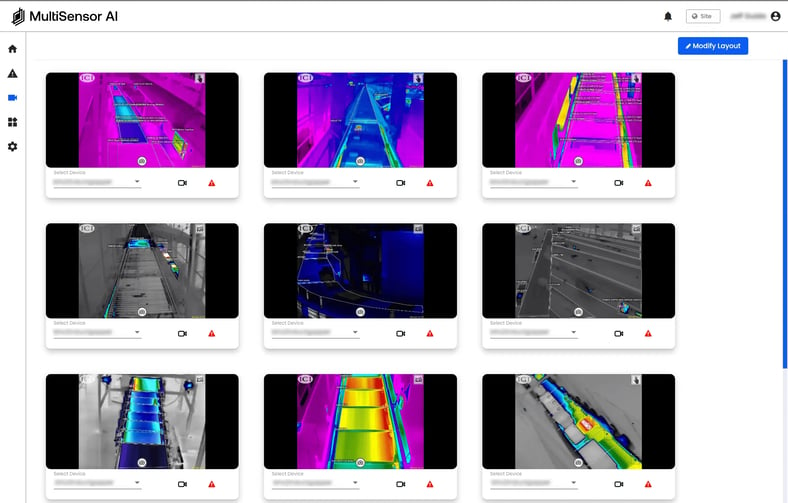
Condition-based monitoring defines when to act. Modern condition monitoring systems enhance this approach by correlating thermal, vibration, visual, and electrical signals to extend detection windows and improve fault interpretation.
Learn how a multi-sensor condition monitoring system supports condition-based maintenance decisions across motors, conveyors, and electrical infrastructure.
Keep reading

Thermal Monitoring Condition Monitoring Blog
How We Taught Solar Monitoring to Stop Mistaking Reflection for a Fault

Condition Monitoring Reliability Engineering Blog