Most practitioners believe they'll catch a degrading asset before it fails. In practice, warning signs get seen, and sometimes flagged, but not acted on until the asset has gone down. That's not a detection problem. It's a judgment and prioritization problem: Teams can't reliably tell which signals are noise and which ones matter. For nearly a third (31%) of practitioners, it has happened more than once.
say they can catch degradation before it causes disruption
have missed a warning sign on an asset that later failed
have dismissed a sensor alert that turned out to be a real failure
That gap between confidence and outcomes traces back to monitoring frequency. Scheduled checks assume degradation follows a calendar, but equipment fails whenever stress and wear cross a threshold, often in the days or hours between inspections. Teams that rely on periodic monitoring are trusting a snapshot to represent a continuous process, and that mismatch is exactly where warning signs get missed.
Luke Grice-Lowe Director of Reliability & Maintenance Programs MultiSensor AI“Degradation and failures don't wait to show up at the next inspection. If you're only checking on a calendar basis, you're going to miss problems that develop in between.”
Exposure to failure isn't spread evenly across a facility. It's concentrated in a small set of assets that can halt everything if they go down. That should make prioritization straightforward: Find those assets and watch them closest. Instead, most monitoring effort is spread broadly, leaving the highest-risk points no better watched than the rest.
have at least one asset that represents a true single point of failure
say 21 to 30% of their assets fall into that category
say 31 to 40% of their assets do
Peak season is where reliability risk becomes especially acute. But the frequency with which teams monitor their assets suggests they're exposed to failure exactly when it matters most, when the facility is expected to operate at peak performance.
said 31 to 45% of annual volume is processed during the busiest four-week period
are confident in their ability to ensure uptime during peak periods; 49% are very confident
Asset retirement should happen when an asset is genuinely near the end of its useful life; otherwise, teams risk wasting capital and disrupting operations unnecessarily.
of practitioners have taken a critical asset out of service for replacement or major repair, only to later find it had significantly more usable life remaining
of practitioners say it has happened more than once
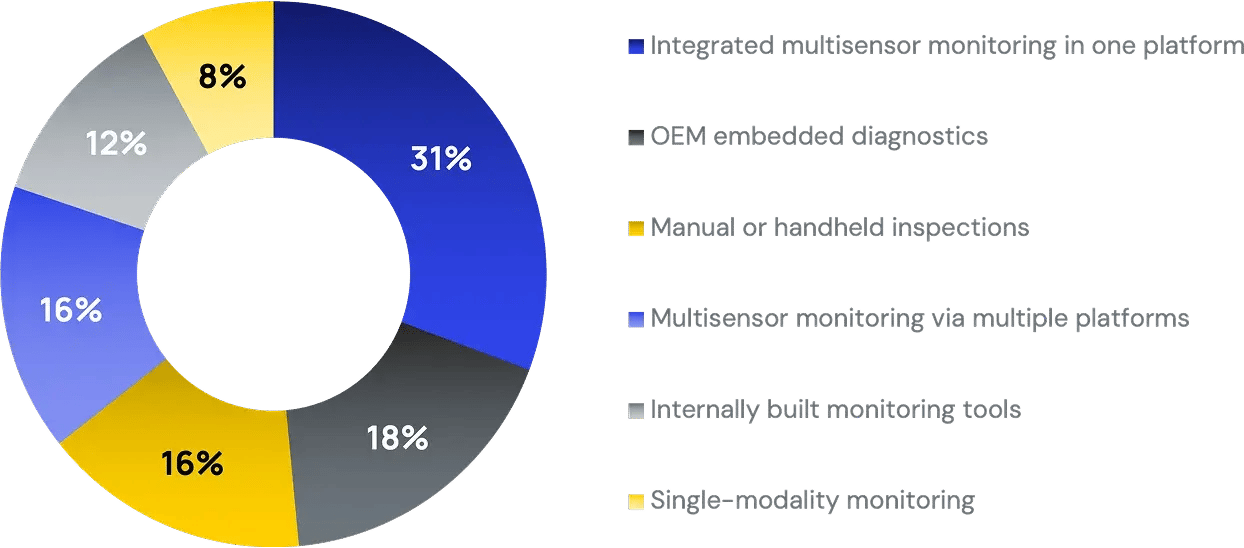
The reason? Most facilities don't have the technology that gives them the visibility needed to get the timing right. Less than a third of practitioners use integrated multi-sensor monitoring in one platform.
Confidence is high, but most teams still monitor on a schedule, the assets that could stop operations get no extra attention, and peak season leaves little margin for error. See where your own program stands, then read on: The next parts of this report cover a reliability workforce under pressure (Part 3), a boardroom that often can't see uptime at all (Part 4), and five concrete steps to close the gap (Part 5).
This is one part of a five-part report. See the full picture, including the workforce and boardroom findings, and five steps to close the gap.
Confidence and detection are two different things. 99% of practitioners in our survey said they're confident they can catch degradation before it causes a disruptiondisruption, yet 83% have missed a warning sign on an asset that later failed, and 82% have dismissed a sensor alert that turned out to be a real failure. The report describes this as a judgment and prioritization problem more than a detection problem: teams often don't have a reliable way to tell which signals are noise and which ones matter.
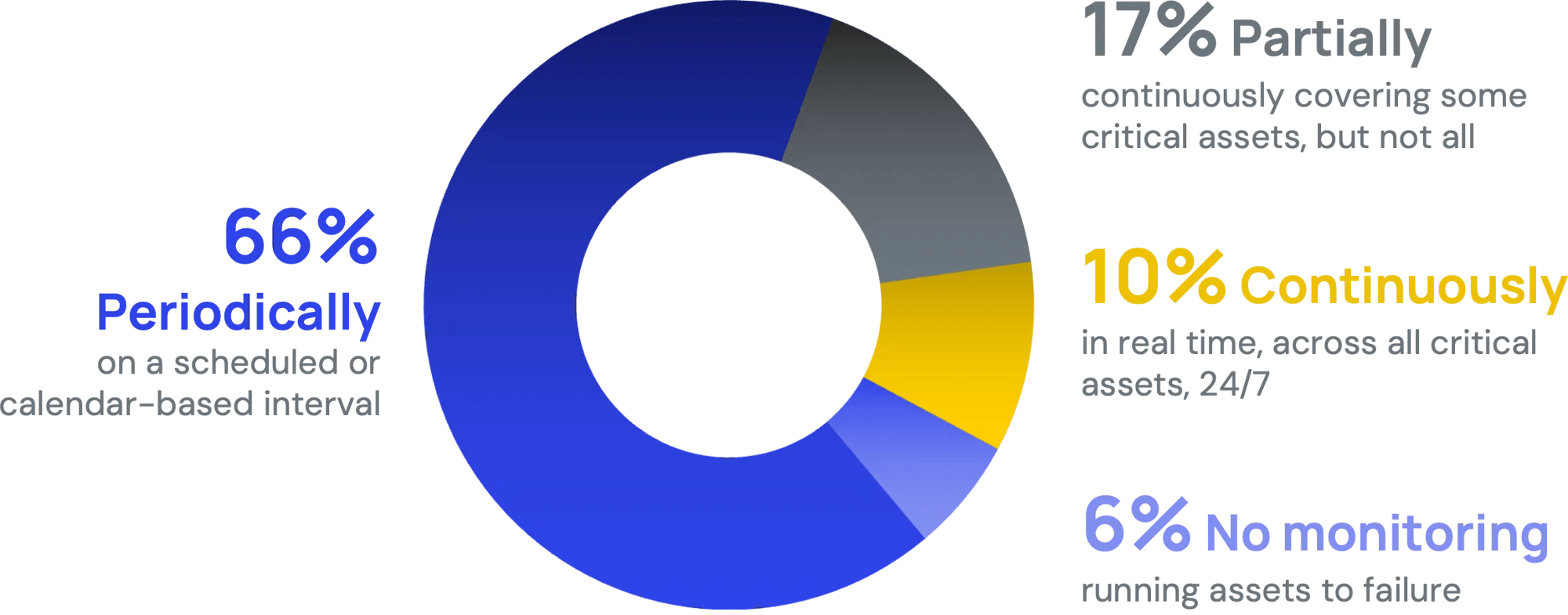
Most don't monitor continuously. Among practitioner respondents, 66% monitor critical assets on a scheduled or calendar-based interval, 17% continuously cover some critical assets but not all, 10% monitor all critical assets in real time, 24/7, and 6% do no monitoring and run assets to failure. Scheduled checks assume degradation follows a calendar, but equipment often fails in the days or hours between inspections.
See how MultiSensor AI provides continuous condition monitoring for high-volume distribution and fulfillment centers.
A single point of failure is an asset whose failure could halt operations. 98% of respondents have at least one asset that represents a true single point of failure, 40% say 21 to 30% of their assets fall into that category, and 14% say 31 to 40% do. Because that exposure is concentrated in a small set of assets, the report's conclusion is that teams should find those assets and watch them most closely, yet most monitoring effort is spread broadly instead.
45% of respondents said 31 to 45% of their annual volume is processed during the busiest four-week period, and 96% are confident in their ability to ensure uptime during peak periods (49% are very confident). But because most teams monitor periodically rather than continuously, they may be exposed to failure at the moment the facility is expected to operate at peak performance.
86% of practitioners say they have taken a critical asset out of service for replacement or major repair, only to later determine it had significantly more usable life remaining, and 27% say it has happened more than once. The report points to a visibility problem: most facilities don't have the technology to get the timing right, and fewer than a third (31%) of practitioners use integrated multi-sensor monitoring in one platform.
The findings come from The Uptime Economy: 2026 Report, independent research conducted by Censuswide between May 27 and June 4, 2026. The survey included 152 US-based respondents split evenly between reliability and maintenance practitioners (engineer through director-level roles) and VP-level operations leaders, and evenly across e-commerce distribution and carrier, courier, and parcel networks. Charts labeled “Practitioner respondents (n=77)” reflect the practitioners in that sample. Full methodology details are available in the complete report.
Get all 22 pages, including the complete workforce and boardroom-visibility data, five steps to close the reliability gap, and full survey methodology.
We'll also send you occasional research and insights from MultiSensor AI. You can unsubscribe at any time.