Every failure starts as a detectable signal. Most operations just find out too late.
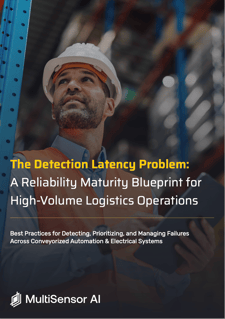
Get the Reliability Maturity Blueprint, a practical model for closing the detection latency gap across sorters, conveyors, drives, and electrical systems in high-volume logistics operations.
- The Reliability Maturity Model: Four tiers of asset criticality, and the maintenance strategy each one calls for.
- The Asset-Level Detection Gap Analysis: Where the five highest-blast-radius asset classes stand today, and where the detection gaps are.
- The Financial Model and Implementation Roadmap: A conservative framework for sizing the case and a roadmap for rolling it out without monitoring everything at once.
Get the Blueprint
Delivered to your inbox. No commitment.
Used by reliability teams at leading distribution and logistics operators










 Four frameworks, one practical path to closing the gap
The Blueprint breaks the detection latency problem into four practical frameworks:
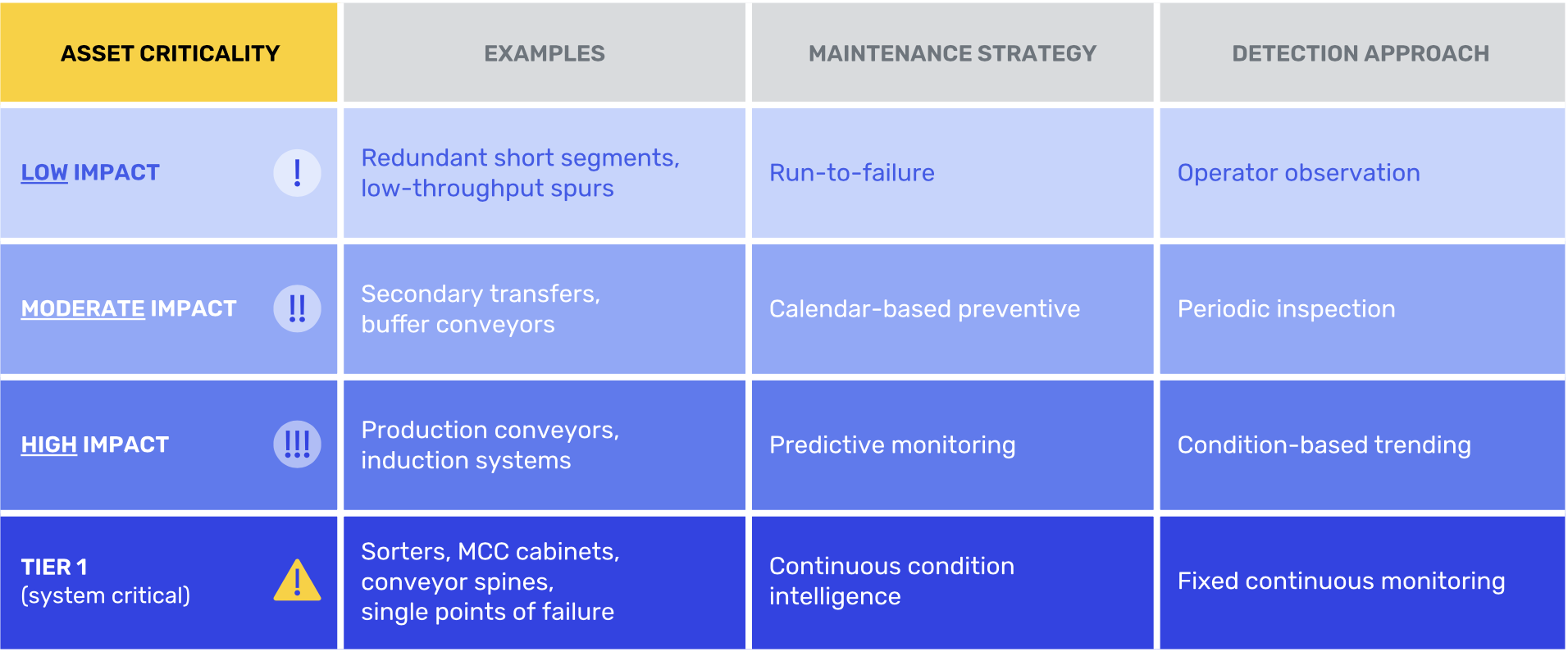
- The Reliability Maturity Model — Four tiers, from run-to-failure to continuous condition monitoring intelligence, and the maintenance strategy and detection method appropriate to each.
- The Asset-Level Detection Gap Analysis — Failure modes, typical detection windows, and current practice for the five asset classes with the widest blast radius: high-speed sorter drives, MCC and VFD cabinets, conveyor trunks and merge clusters, induction and singulation systems, and control cabinets.
- The Financial Model of Early Detection — A conservative, facility-specific structure for sizing the economic case, built from your own downtime history and labor costs rather than someone else's deployment data.
- The Implementation Roadmap — The sequence for rolling out condition intelligence deliberately: map bottlenecks, identify single points of failure, assess current detection methods, and expand from evidence.
Match your maintenance response to the maintenance risk
Reliability maturity isn't about applying continuous monitoring to every asset. It's about matching the detection approach to the operational consequence of failure.
Give your team the time to act with condition-based monitoring
Built for reliability, engineering, and operations leaders running high-throughput conveyorized operations: distribution centers, parcel and courier hubs, and other automation-dependent facilities where a single sorter, drive, or electrical fault can stop the whole line.