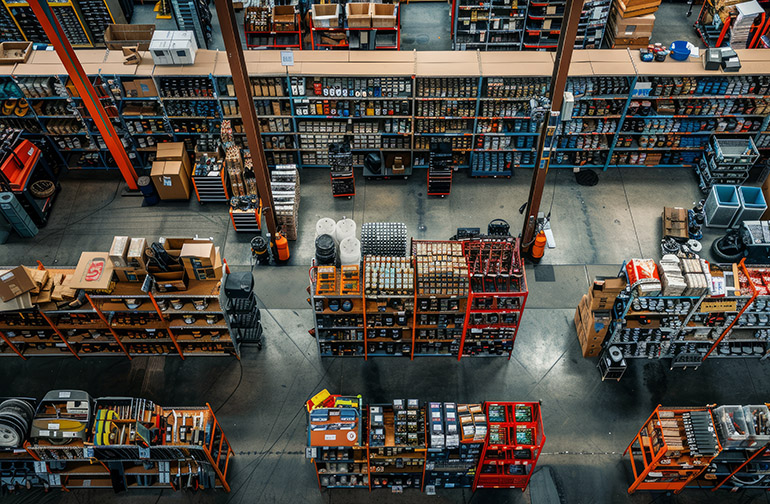
A Fortune 50 online retailer operates a global network of high-volume distribution facilities, each responsible for moving and sorting thousands of packages daily across interconnected conveyance systems. Uptime in these environments is not a reliability metric — it is a direct driver of throughput, labor efficiency, and customer satisfaction.

The facility's maintenance team was not operating without a process. Monthly inspections using handheld thermal imaging devices were conducted across critical assets. Maintenance schedules were in place. But unplanned downtime events kept occurring — each one idling workers, disrupting throughput, and generating five-figure costs before the repair was complete.
The challenge
Three critical conveyance assets — responsible for the continuous movement and sortation of packages — were the primary failure points. Despite regular inspection, each had failed without prior warning detectable during scheduled walkarounds.
The cost structure was unambiguous. The facility calculated idle labor alone at $5,000 per hour during downtime events, with an average repair window of two hours per incident. That $10,000 floor represented only a fraction of the total impact — lost throughput and downstream disruption pushed overall waste into the hundreds of thousands of dollars across the facility.
The underlying problem was structural, not procedural. Handheld thermal inspections capture a single moment in time. Mechanical and electrical degradation — bearing wear, belt tension creep, motor overload — progresses continuously between those moments. The inspection gap was not a gap in effort. It was a gap in visibility.
The solution
MultiSensor AI deployed three FMX400 fixed-mount thermal monitoring units across the distribution facility's critical conveyor infrastructure, integrated with the MSAI Connect condition intelligence platform.
Rather than replacing the existing maintenance workflow, MSAI Connect operated as a continuous intelligence layer above it — monitoring asset condition 24/7 and flagging early signs of degradation before failure conditions were reached. Alerts were delivered directly into the team's existing workflow, enabling the maintenance team to schedule intervention during planned downtime windows rather than responding to unplanned ones.
The solution was designed around three objectives: (1) identify issues before failure, (2) use scheduled downtime for repairs, and (3) eliminate the visibility gap that periodic inspections could not close.
The results
Within the first 30 days of deployment, MSAI Connect identified three imminent critical failures — each detected early enough to repair on schedule:
-
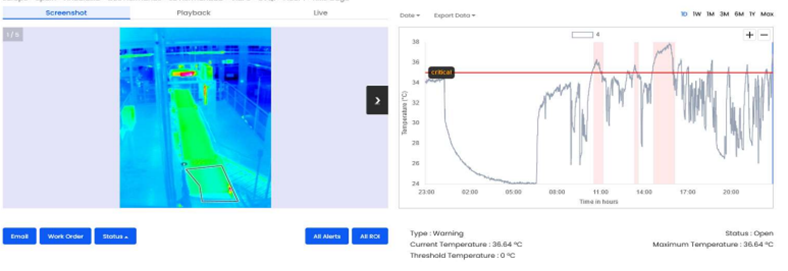
Conveyor belt overheating — The system flagged a belt running approximately 20°C above its normal operating temperature, indicating developing friction and tension stress. Maintenance repaired the belt during a planned downtime window.
Estimated cost avoided: $10,000.
-
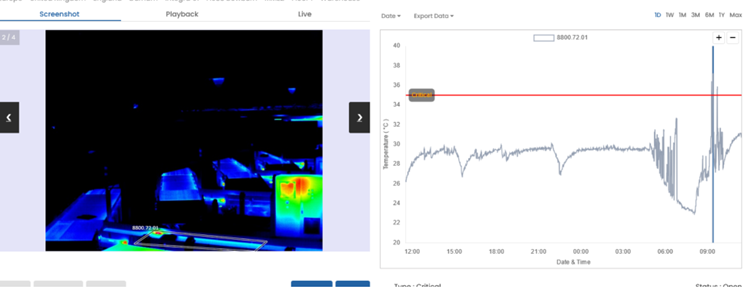
Motor degradation — A motor running 30°C above its expected temperature range was identified before failure. The motor was replaced during scheduled maintenance rather than after an emergency shutdown.
Estimated cost avoided: $15,000. -
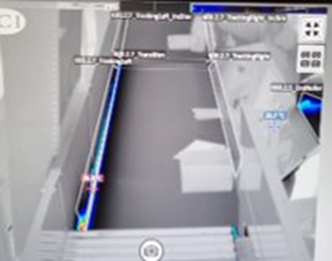
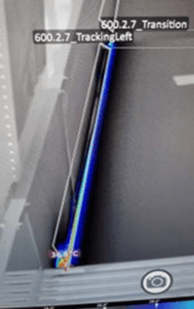
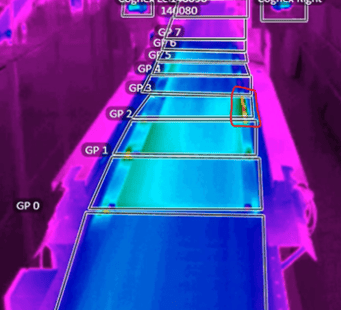
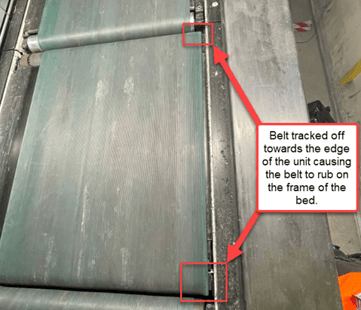
Belt tracking fault — An angled induct belt alarmed the system as it began to track laterally and rub against its edge. Workers corrected the alignment before belt damage caused a line shutdown.
Estimated cost avoided: $10,000.
Total first-month cost avoidance: approximately $35,000.
Full ROI achieved within 30 days of deployment.
The outcome
The results at the initial facility were significant enough that the retailer socialized the solution internally across its global operations network. MSAI Connect is now being deployed across multiple additional distribution facilities worldwide.
The broader shift was operational: from a maintenance model defined by scheduled inspection and reactive response, to one defined by continuous condition visibility and planned intervention. The difference is not a better inspection process — it is the elimination of the visibility gap that periodic inspections cannot address.
Why continuous condition monitoring matters for distribution facilities
For high-throughput distribution and fulfilment environments, the economics of continuous condition monitoring are direct:
-
A single avoided downtime event on a critical conveyor typically recovers deployment cost
-
Repairs scheduled during planned downtime eliminate emergency labor premiums and unplanned parts consumption
-
Continuous monitoring scales across facilities without requiring dedicated reliability engineering headcount
MSAI Connect is designed for lean reliability teams in high-velocity environments. No specialist staff required. No new system of record to manage. Subscription-based deployment removes the CapEx barrier, converting infrastructure investment into a predictable operational cost with a measurable payback window.
Learn how MSAI Connect delivers continuous condition intelligence for distribution and e-commerce operations — or schedule a demo to discuss your facility's monitoring requirements. Explore MSAI Connect for Distribution, Warehouses and Logistics here.