
Thermal Monitoring Condition Monitoring Blog
TL;DR
-
Solar panel glass reflects heat in a way that looks exactly like a developing fault on a thermal camera, and it's easy to mistake for real degradation.
-
Raising alert thresholds to cut down reflection noise also filters out the early stage of a real fault, the exact thing continuous monitoring exists to catch.
-
Solar Reflection Analysis evaluates every ambiguous alert against time of day and sun position and returns a confidence read-out instead of a yes/no filter.
-
Confirmed reflection is logged and closed automatically. Confirmed faults and uncertain events go straight to the team, and nothing closed is ever deleted.
- It's available now inside Solar Performance Monitoring, no extra setup for sites already running MSAI Connect, and it runs alongside existing SCADA and inspection programs rather than replacing them.
Why reflection needs its own interpretation layer, not just a better threshold
Starting today, Solar Performance Monitoring includes Solar Reflection Analysis, built to solve one specific problem: distinguishing a real fault from sunlight bouncing off a panel.
Here’s an example: A DC connector at a combiner box started to work loose. Nothing had failed yet. Nothing had tripped an alarm. The only sign was heat building slowly at a single connection point, the kind of change a thermal camera watching that combiner box every day would catch immediately, and the kind of change a drone flight twice a year would only find by chance.
Continuous infrared caught it while it was still a proactive activity instead of an emergency. A technician was dispatched to the site, tightened the connection, and closed the job. No arc, no fire risk, no unplanned outage. As the facilities and energy operations lead on that site put it: “Heat is the early language of a fire. For years I had no way to hear it day to day.”
That's a good case for continuous thermal monitoring. But it only works because the system wasn't also drowning that team in false alarms from something else entirely: sunlight.
The problem hiding inside every solar array
Solar panel glass reflects heat specularly. A nearby vehicle, a piece of reflective equipment, or simply the sun sitting at a low angle late in the day can bounce a heat signature straight into a thermal camera and make it look exactly like a developing fault. Another common source we've encountered in deployments is puddles, morning dew, or condensation on the panel. A technician on a drone flight can re-shoot the same spot from another angle to check. A fixed camera can't. It sees one view, and from that view, reflection and genuine degradation can be indistinguishable.
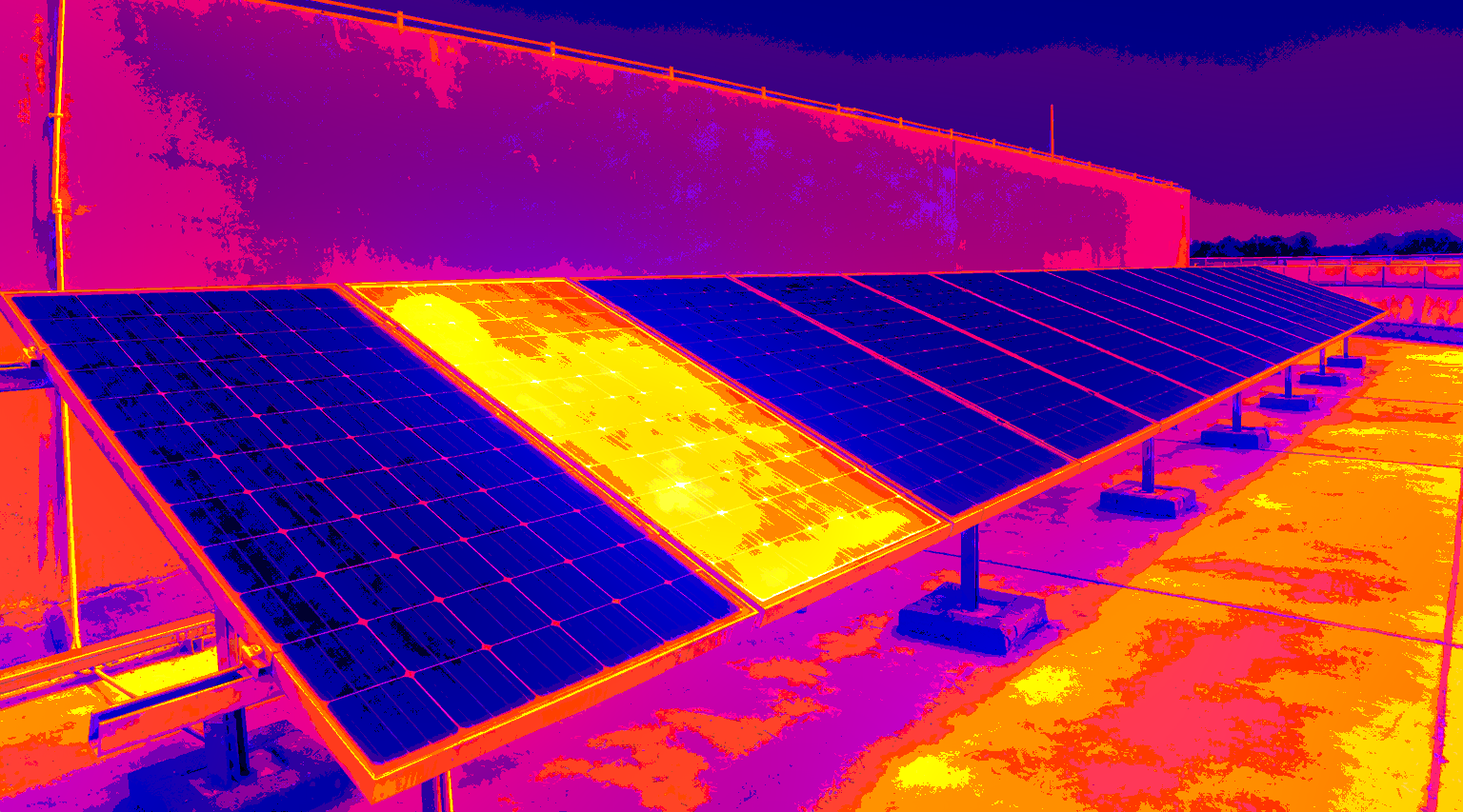
The industry's default fix has been to raise the alert threshold until the noise quiets down. It works, until it doesn't: The same threshold that filters out a reflection event also filters out the early stage of a real fault, the exact thing continuous monitoring exists to catch.
What Solar Reflection Analysis does instead
Solar Reflection Analysis doesn't filter reflection out and hope nothing important goes with it. It builds a case for every ambiguous alert, weighing the time of day and the sun's position. That evaluation produces a confidence read-out, how closely the pattern matches known reflection behavior, which travels with the alert instead of replacing it.
When the pattern lines up with what reflection typically looks like, the alert carries a confidence read-out and the visual frame, so the operator can confirm it at a glance instead of dispatching someone to check.
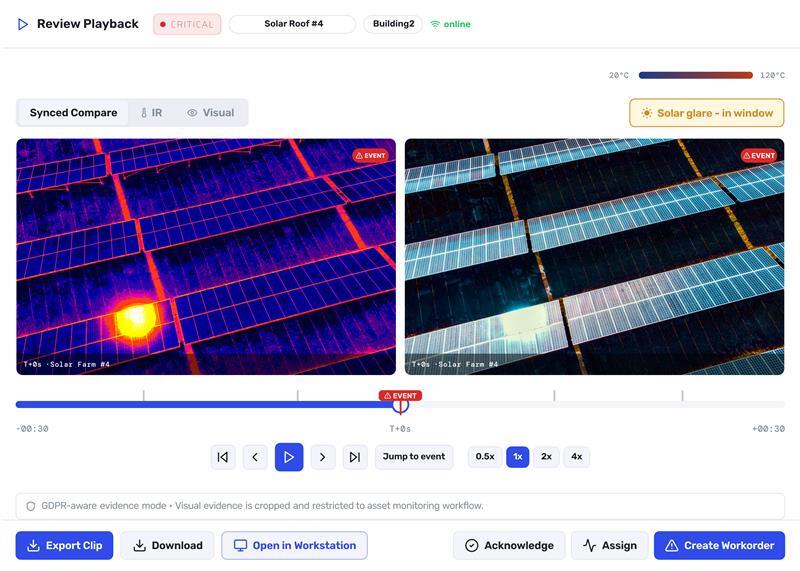
Confirmed reflection is logged and closed. Confirmed faults and uncertain events go straight to the team. Closed events aren't deleted; every alert, resolved or escalated, stays logged and reviewable in the account's history. That distinction matters more than it sounds: An interpretation layer that quietly erases events it thinks are noise is a system nobody can fully trust, and trust is the entire reason continuous monitoring exists in the first place.
Why this matters beyond solar
Reflection is a solar-specific version of a problem every condition-monitoring program eventually runs into, and it won't be the last place we apply this fix. More on that soon.
What's included
Solar Reflection Analysis is available now inside Solar Performance Monitoring, with no additional deployment step for sites already running MSAI Connect. It works alongside your existing SCADA / BMS and enhances your inspection program. It doesn't replace either.
What next? Talk to an engineer, or read the full Solar Performance Monitoring datasheet.
FAQs
What is Solar Reflection Analysis?
It's a capability inside Solar Performance Monitoring that checks every ambiguous thermal alert against time of day and sun position, then returns a confidence read-out showing how closely the pattern matches known reflection behavior.
How is this different from just raising the alert threshold?
A threshold is a single cutoff applied to every alert the same way, so anything that quiets reflection noise also quiets real early-stage faults. Solar Reflection Analysis evaluates each alert individually and returns context, a confidence read-out, instead of a blanket filter.
Does this replace SCADA or my inspection program?
No. It runs alongside your existing SCADA and inspection routine. It doesn't replace either.
What happens to alerts that turn out to be reflection? Are they deleted?
No. Confirmed reflection is logged and closed automatically. Nothing closed is ever deleted, every alert, resolved or escalated, stays reviewable in your account's history.
Do I need to do anything to get this if I already use MSAI Connect?
No additional deployment step is required for sites already running MSAI Connect. Solar Reflection Analysis is included inside Solar Performance Monitoring now.
Keep reading

Condition Monitoring Reliability Engineering Blog
The $125K/Hr. Problem: Why Logistics Operations Detect Failures Too Late
Condition Monitoring Reliability Engineering Blog