Keeping equipment running comes with real stress. While 92% of practitioners would recommend a career in reliability and maintenance, 69% say it comes with caveats. The work is meaningful, but the pressures around uptime, automation, and workforce challenges are significant.
of all respondents said a lean workforce, and not enough skilled technicians, are top barriers to improving uptime
of practitioners would recommend a career in reliability and maintenance
of practitioners say that career comes with caveats
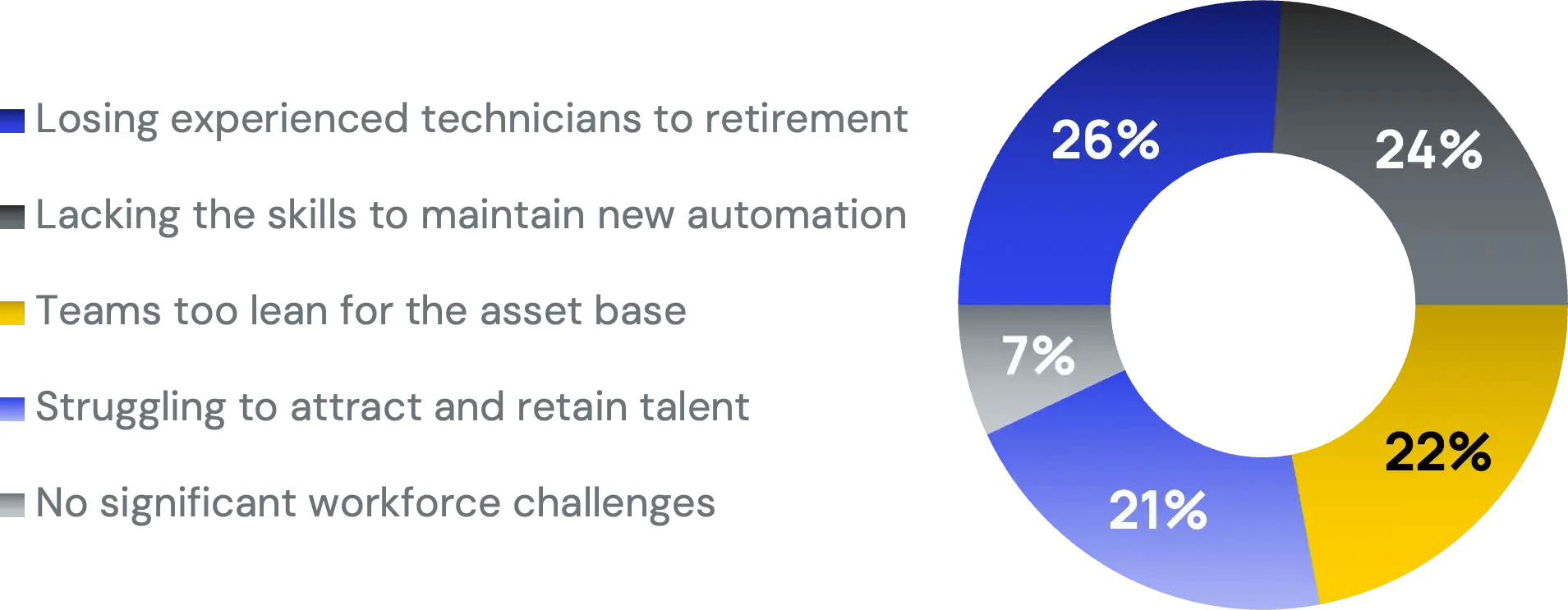
The strain comes from four directions at once: retiring technicians taking knowledge with them, skills that lag increasingly complex automation, teams too lean for their asset base, and difficulty attracting new talent. No single one is dominant enough to solve in isolation. Losing an experienced technician removes undocumented institutional knowledge, not just headcount, and with fewer people coming in to backfill, the gap compounds.
Base: Practitioner respondents (n=77)

Luke Grice-Lowe Director of Reliability & Maintenance Programs MultiSensor AI"Teams are maintaining a more complex asset base than ever. Continuous monitoring shows them where degradation is actually developing, so the hours they do have go to the right assets."
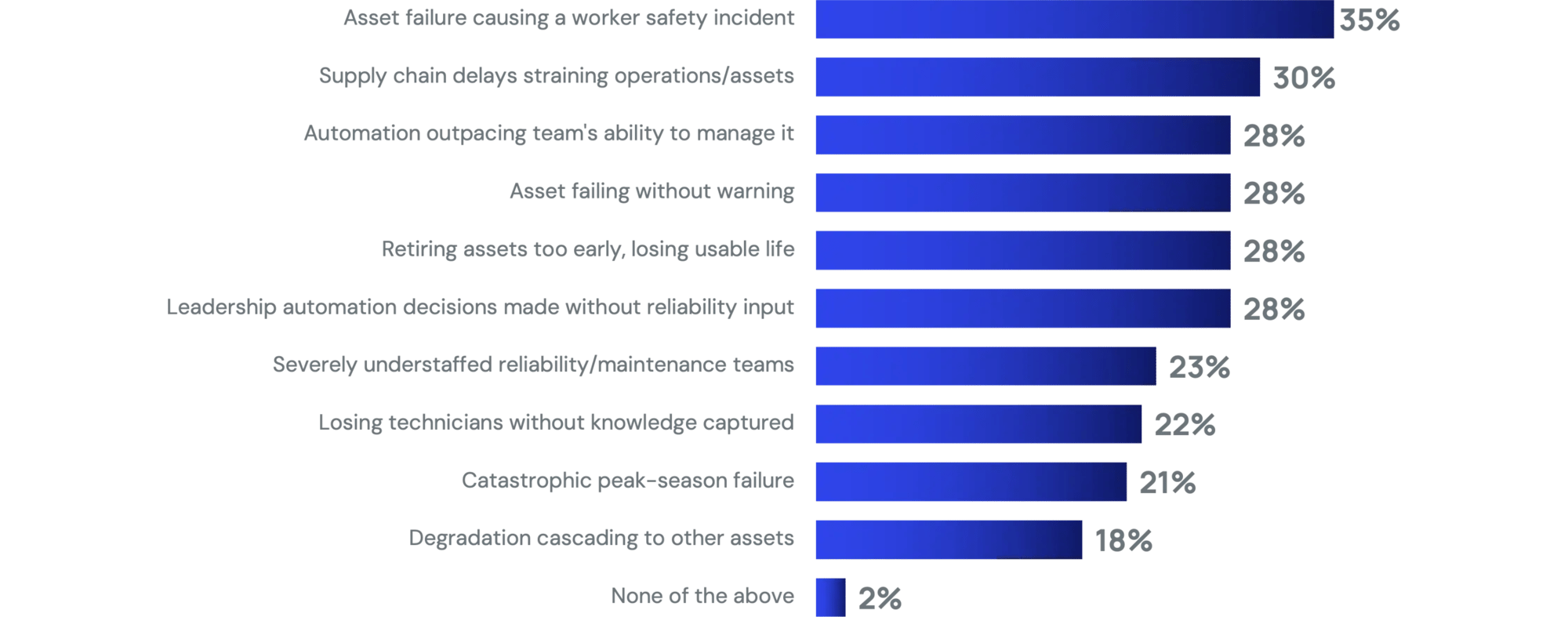
Reliability and maintenance practitioners aren't worried about one single failure mode. Their concerns span safety, supply chain strain, workforce capacity, and leadership blind spots in roughly equal measure. And that flatness is itself telling: There's no single fix that would put anyone's mind at ease.
Base: Practitioner respondents (n=77)
Teams are maintaining a more complex asset base with a workforce that is retiring, stretched thin, and hard to replace. No single failure mode dominates their worries, and no single fix relieves the pressure. See where your own program stands, then read on: Part 4 covers a boardroom that often can't see uptime at all, and Part 5 lays out five concrete steps to close the gap.
This is one part of a five-part report. See the full picture, including the workforce and boardroom findings, and five steps to close the gap.

The strain comes from four directions at once: experienced technicians retiring, skills that haven't kept pace with complex automation, teams too lean for the asset base, and difficulty attracting new talent. Among practitioners, 92% would recommend a career in reliability and maintenance, but 69% say it comes with caveats. Across all respondents, 35% said a lean workforce and not enough skilled technicians are top barriers to improving uptime.
Among practitioners, 26% name losing experienced technicians to retirement as their top workforce challenge, 24% say their teams lack the skills to maintain new automation, 22% say teams are too lean for the asset base, and 21% struggle to attract and retain talent. Only 7% report no significant workforce challenges. No single challenge dominates, which is what makes the pressure hard to relieve.
Losing an experienced technician removes more than headcount. It removes institutional knowledge that was never documented anywhere else, and with fewer new people coming in to backfill, the gap compounds. In the survey, 26% of practitioners named retirement as their top workforce challenge, and 22% said losing technicians without knowledge captured keeps them up at night.
Worker safety leads: 35% of practitioners worry about an asset failure causing a worker safety incident, followed by supply chain delays at 30%. Four threats tie at 28%: automation outpacing the team's ability to manage it, assets failing without warning, retiring assets too early, and leadership automation decisions made without reliability input. The concerns are spread roughly evenly, so there is no single fix that settles them.
Reliability teams can't be everywhere at once. The report recommends continuous monitoring to fill the visibility gap and help teams focus attention on the assets and issues that carry the most risk.
The findings come from The Uptime Economy: 2026 Report, independent research conducted by Censuswide between May 27 and June 4, 2026. The survey included 152 US-based respondents split evenly between reliability and maintenance practitioners (engineer through director-level roles) and VP-level operations leaders, and evenly across e-commerce distribution and carrier, courier, and parcel networks. Charts labeled “Practitioner respondents (n=77)” reflect the practitioners in that sample. Full methodology details are available in the complete report.
Get all 22 pages, including the complete workforce and boardroom-visibility data, five steps to close the reliability gap, and full survey methodology.
We'll also send you occasional research and insights from MultiSensor AI. You can unsubscribe at any time.