
people-taking-part-business-event
The Uptime Economy: 2026 Report

Part 4: Uptime Not Yet a KPI in the Boardroom

If one major downtime event could cost a full year of automation investment, why isn't uptime tracked in the boardroom? Explore the issue in Part 4 of five from The Uptime Economy: 2026 Report, our survey of 152 reliability, maintenance, and operations leaders across e-commerce, warehousing, logistics, and parcel networks.

One Bad Event Could Cost a Year of Automation Investment

A major downtime event could cost a full year of automation investment, a major concern for any industrial leader. Uptime and reliability protect more than the ability to avoid failure. They protect the production and throughput that automation is built to deliver, and both should be prioritized alongside continued automation investment.

Among VP-level respondents

  • 40%

    estimate the financial impact of a major downtime event would exceed their annual automation investment at a facility

  • 55%

    say the financial impact would be roughly equal to their annual automation investment

  • Those automation investments are substantial. When we asked VPs about the average total investment per facility in automation technology—including equipment, installation, and integration—over the past three years, here’s what they said:

  • 35%

    of VPs estimate between $25.1 and $100 million per facility

  • 55%

    of VPs estimate between $5 million and $25 million per facility

High Stakes, Low Visibility

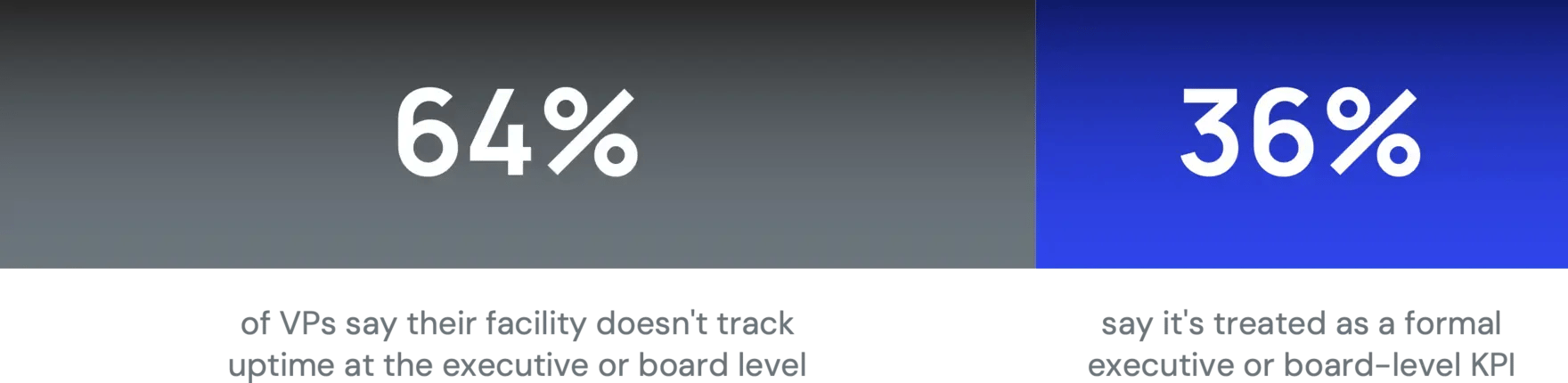
Despite the high stakes, uptime doesn't often reach executive and board-level decision makers. Nearly two thirds of VPs say their facility doesn't track uptime at the executive or board level. Just over a third say it's treated as a formal executive or board-level KPI that is tracked regularly alongside financial and operational performance.

The lack of board and executive awareness and urgency is felt across levels:

  • 31%

    of practitioners say their board views uptime as a strategic priority

  • 36%

    of VPs say their board views uptime as a strategic priority

Leadership Is Missing Vital Signals...

How far does uptime reach?
img-186
...And Flying Blind on Downtime Costs

Only 30% of respondents know what a major unplanned downtime event costs their facility per hour.

What This Means

One bad event could cost as much as a year of automation investment, yet most facilities don't track uptime at the executive or board level, and only 30% know what a major downtime event costs per hour. See where your own program stands, then read on: Part 5 lays out five concrete steps to close the gap, starting with putting an uptime KPI on the board and executive agenda.

Get the Complete Picture

This is one part of a five-part report. See the full picture, including the workforce and boardroom findings, and five steps to close the gap.
Cover of The Uptime Economy: 2026 Report.

Frequently Asked Questions

How much could a major downtime event cost compared with automation investment?

Among VP-level respondents, 40% estimate the financial impact of a major downtime event would exceed their annual automation investment at a facility, and 55% say it would be roughly equal. Those investments are substantial: 35% of VPs estimate average automation spending per facility over the past three years at between $25.1 and $100 million, and 55% estimate between $5 million and $25 million.

Do executives and boards track uptime?

Mostly not. 64% of VPs say their facility doesn't track uptime at the executive or board level, while 36% say it is treated as a formal executive or board-level KPI tracked regularly alongside financial and operational performance. Only 31% of practitioners and 36% of VPs say their board views uptime as a strategic priority.

Do facilities know what downtime costs per hour?

Few do. Only 30% of respondents know what a major unplanned downtime event costs their facility per hour. Without that number, it is hard to know whether monitoring investment matches actual exposure.

Why should uptime be a board-level KPI?

Uptime and reliability protect the production and throughput that automation is built to deliver. The report recommends getting an uptime KPI on the board and executive agenda and tracking it alongside revenue and cost, so reliability decisions get visibility equal to their dollar impact.

How can a facility establish its cost of downtime?

The report recommends establishing a documented downtime cost baseline per asset or line, so investment decisions are grounded in dollars, not assumptions.

Where did this data come from?

The findings come from The Uptime Economy: 2026 Report, independent research conducted by Censuswide between May 27 and June 4, 2026. The survey included 152 US-based respondents split evenly between reliability and maintenance practitioners (engineer through director-level roles) and VP-level operations leaders, and evenly across e-commerce distribution and carrier, courier, and parcel networks. Charts labeled “Practitioner respondents (n=77)” reflect the practitioners in that sample. Full methodology details are available in the complete report.